Conway’s Game of Life: Next Lab Edition
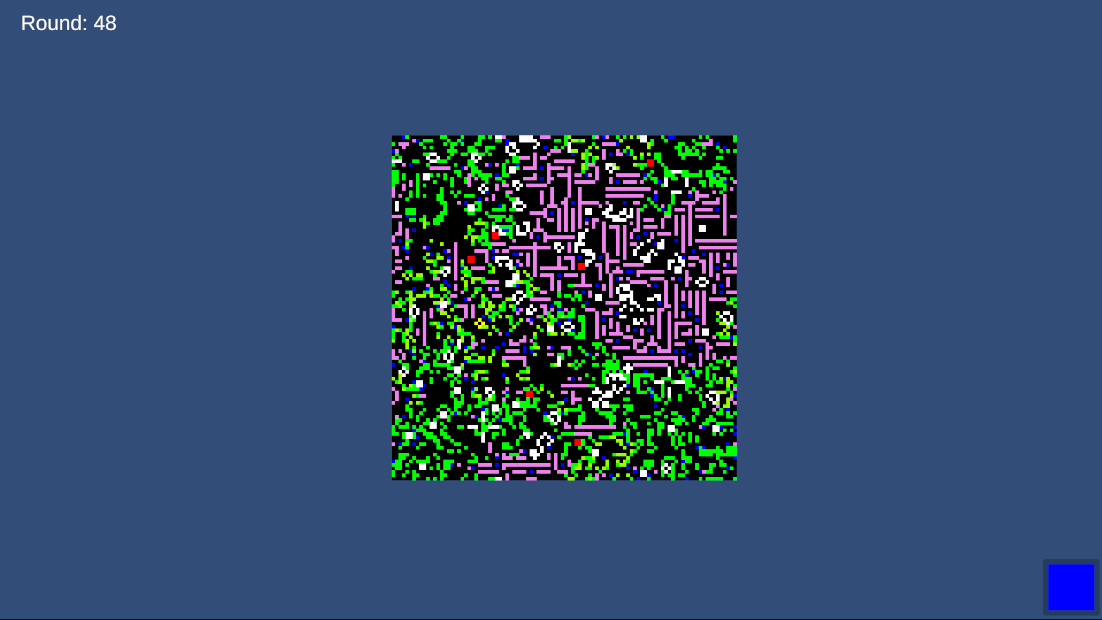
The Next Lab Games and Spatial Computing Guild’s take on Conway’s Game of Life turns a classic math toy into an interactive, kaleidoscopic sandbox built in Unity. Instead of a single “alive vs dead” state, cells can take on multiple colors—each with its own ruleset and behavior. The result is a deterministic but endlessly surprising system: swirling, colliding patterns of color that feel half-simulation, half-generative art. Players can paint initial conditions directly onto the grid, tweak how often each color appears, and then watch as the simulation evolves into intricate, repeatable designs that look like living stained glass.
This project reimagines Conway’s Game of Life as a multi-color, rules-driven playground. Each color—White, Blue, Green, Lime, Yellow, Red, and more—comes with custom logic that changes how it lives, dies, spreads, or remains inert. Built in Unity as a WebGL experience, the simulation lets players sculpt starting patterns, tune color weights, and explore how small changes lead to radically different emergent behavior.
Core Simulation & Color Logic: At its foundation, the project still honors the original Game of Life: cells live or die based on their neighbors. But instead of a binary world, we introduce a spectrum of colors, each with its own twist on Conway’s rules.
- White behaves like standard Game of Life: classic birth and survival rules.
- Black represents dead/off cells—the empty canvas.
- Blue is inert: once blue, a cell resists change and doesn’t toggle on or off, acting like an anchor in the pattern.
- Green is “social”: it follows normal rules, but counts any non-black, non-blue neighbor as alive, allowing it to thrive in mixed-color environments.
- Lime acts like a “disease” color, designed to spread and influence nearby cells more aggressively.
- Yellow applies Game of Life rules diagonally, producing patterns that grow along slanted axes.
- Red applies Game of Life rules only to adjacent neighbors (up, down, left, right), creating sharper, directional behavior.
Behind the scenes, each rule is defined as a flexible object that operates only on the state of the previous frame. Conditions can check: how many neighbors are active, how many neighbors of a given color exist, or whether a specific direction (top, bottom, left, right) contains a certain color. This makes the system deterministic, extensible, and perfect for experimenting with new colors and behaviors.
Player Interaction & UI: The simulation runs on a 100×100 grid in a Unity 2D scene, with a strong focus on player control and readability. At any time, players can:
- Pause and paint: Stop time, click or drag to “paint” colors directly onto the canvas, and sculpt intricate starting states.
- Swap colors via hotkeys: Number keys switch the currently selected color; the UI displays which color is active.
- Track populations: A live UI tracker shows how many cells of each color are present after every step, making it easy to see which rules are dominating the board.
Camera controls are being refined to feel as natural as working in a creative tool: fixing screen tearing while panning, resolving “max pan” issues, and ensuring zooming always targets the cursor position.
Technical Design & Future Roadmap: Technically, the project is built for flexibility and experimentation. Each cell only ever modifies itself, never its neighbors, ensuring rules remain local and predictable. Rules are implemented as configurable assets and processed in order; this architecture makes it straightforward to add new colors/behaviors, experiment, and scale the project with ease and minimal code changes. With this in mind, some ideas on the project’s future roadmap include customization options, easter eggs, and bigger grids for large-scale simulations.
Project showcase:
Launch date:
- December 2025
Contributors & Credits:
- Jayden Robles, Next Lab Associate, Games and Spatial Computing Guild Lead
- Jose Sanchez, Next Lab Associate
- Donovan Harp, Next Lab Associate
- Divyanshu Parikh, Next Lab Associate
- Ananya Basarkar, Next Lab Associate
- Carter Vaughn, Next Lab Volunteer
ASU Next Lab™
Powered by collaboration across ASU’s innovation ecosystem.
Got an idea, project, or question? Connect with Next Lab →